Before there was Mixed Heritage Press (MHP), there were other books – poetry books. One of the first I wrote was Love, Don’t Fear – Poetry Collection, first published in 2018.
These days, I almost consider it part of my archives. However, an English book club based in Austria reached out to me recently about featuring it. The club was inviting a small selection of authors to take part in its international author series.
The organiser wrote, “What stayed with me about Love, Don’t Fear is the way the collection looks at relationships without pretending they are always easy. The movement from heartbreak and uncertainty toward recovery, restoration, hope, and faith gives the poems a very personal quality. I also liked the idea behind the title itself – choosing love without allowing fear to define how we connect with others.”
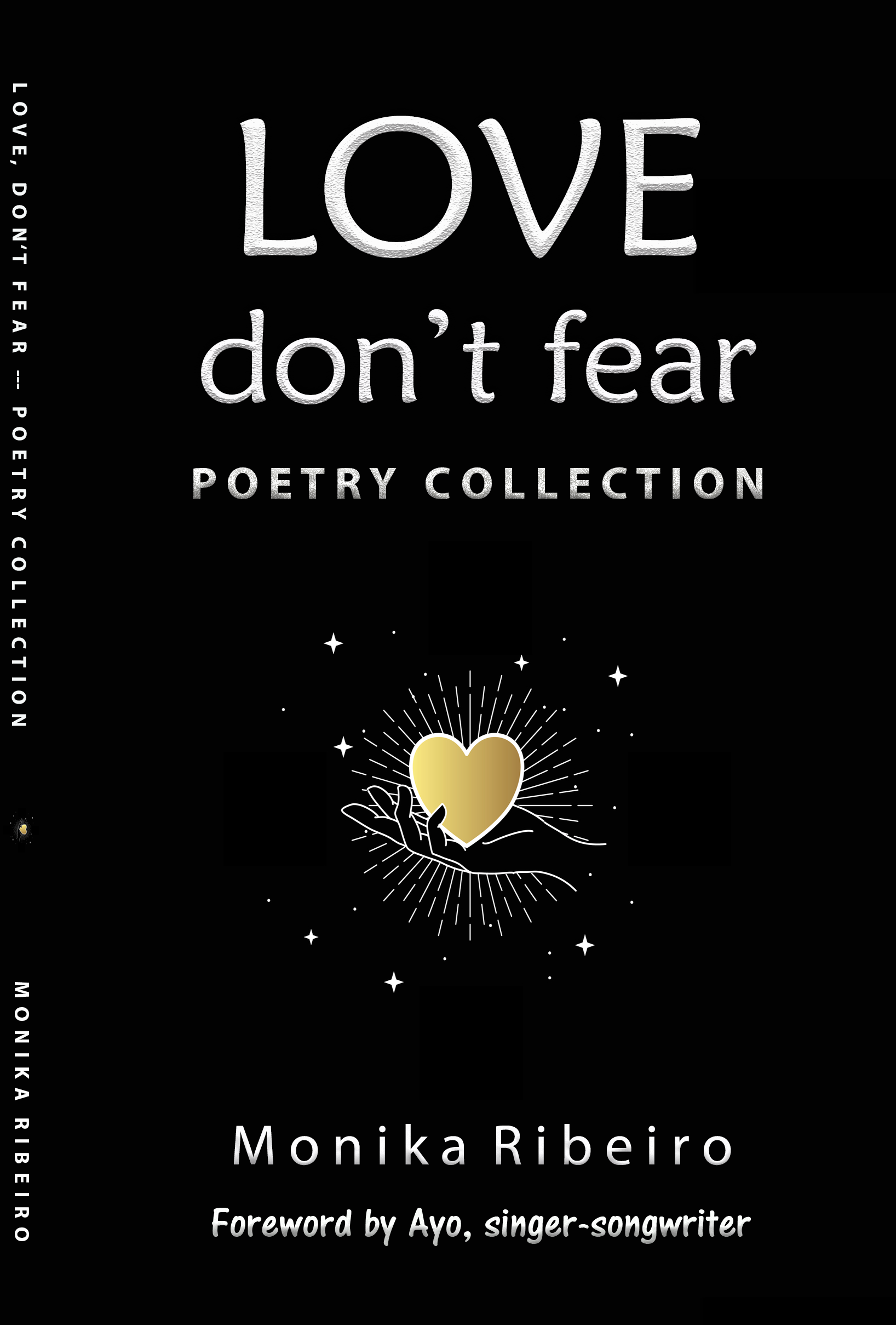
It was wonderful to reconnect with this book and its themes. Much of what I write and publish through MHP explores mixed heritage, but Love, Don’t Fear reaches into the more encompassing category of simply being human.
As part of the book club’s preparation for the feature, I was sent a set of questions about the poetry. Answering them took me longer than I expected, partly because I had to go back and re-read the book… and get re-introduced to the woman who wrote it.
I found myself measuring who I am now against who I was then.
Do I still believe what I believed? Do these poems still say what I’d like to say? Have they survived the test of time?
It was lovely to discover that a book I had put to rest could still generate conversations – including a conversation between my present and former self.
The book club’s questions were very thoughtful, and I found value in answering them. So, I want to give some of the questions they sent me – and my answers – another life here.
Looking beyond the individual poems, what do you believe Love, Don’t Fear says about the freedom we have to decide who we become after someone has hurt us?
I hope it says that the freedom to decide who we become after someone hurts us is our birthright…
Could we really call it freedom if it depended on another human being doing the right thing?
If someone else must apologise, change, not leave, return, love us properly or repair what they broke before we can be free, then at least part of our freedom still belongs to them.
I don’t think that is freedom at all.
Your collection suggests that love can remain meaningful even when another person’s choices are painful. Where do you draw the line between continuing to love someone and learning to protect your own peace?
I wrote Love, Don’t Fear a long time ago. I am a different person – and a different writer – today. Still, I do believe that true love is selfless, and it can remain meaningful even when loving someone becomes painful.
Then again, patience, although inseparable from love, does not always require staying. I touched on this in the very short poem “Love Walks Away.” There are times when leaving means loving yourself enough not to allow another person to keep hurting you.
You can walk away while still loving the person – to protect your peace. The two are not necessarily contradictory.
Many people enter relationships carrying fears created by previous experiences. Do you believe we can truly separate the person we are with now from the wounds created by someone who came before?
I think that can be very difficult.
I wrote a short poem about “echoes of pain,” asking how we know whether the hurt we feel is an alarm warning us about something happening now, or simply an echo of a wound we thought was gone.
Our souls register and remember pain. If we have not healed, we can carry it into places and relationships that had nothing to do with creating it.
But too often we jump into new relationships – especially romantic ones – before we have healed, finding ourselves repeating familiar patterns.
So yes, I believe healing allows us to see the person in front of us more clearly, rather than constantly seeing them through what somebody else did.
Whether it is possible to walk consistently in complete healing on this side of life, I am not entirely sure. I want to believe that it is.
If fear often disguises itself as attachment, control, jealousy, or the need for reassurance, what do you think healthy love looks like when those fears begin to surface?
I would question the premise slightly.
I don’t think attachment is necessarily unhealthy, and I don’t think jealousy automatically means fear. For instance, jealousy can be a natural response in romantic love when boundaries are crossed…
For me, healthy love is not necessarily the absence of attachment, jealousy or reassurance; it is about how those things are expressed and whether they remain in balance.
I explored this in “Too Much Water Kills a Flower.”
A flower needs water. The problem is not the water itself – it is the excess (or lack thereof).
The poem ends with the distinction I would make here: true love seeks to free another person; false love seeks to possess them.
Perfect love is something else again. That, for me, is the love of God.
Was there an idea in Love, Don’t Fear that changed for you while you were writing it – something you initially understood one way but came to see differently through the writing process?
This happened often, although not always as one idea changing into another – which happened too. The poems often came to me when I wasn’t looking for them and revealed themselves gradually as I wrote. I guess one might call that inspired writing.
But also, I had often changed by the end of a poem; my understanding grew. I could begin writing in turmoil, confusion or distress and find that, somewhere in the process, the story gave me comfort. By the time I put the pen down, I often felt freer and clearer than I had when I picked it up.
Writing was not simply a way of recording what I already understood; it was part of how I came to understand it.
At one point, I was attending therapy. My therapist kept arriving at conclusions that I had already reached. Eventually, she noticed this herself and asked how I kept coming to these conclusions.
I told her: through writing, often poetry.
She encouraged me to continue.
That experience further reassured me that something was happening during the writing process – that I was being given, maybe even channelled, answers I had not necessarily possessed in that form when I began.
I should mention that writing was more of a tool, or again a channel – I was pursuing my faith quite intensively too, around the time of writing this poetry collection.
That doesn’t mean every poem in Love, Don’t Fear documents my own experience. It doesn’t. Some stories simply came to me, inspired by different people, observations or circumstances.
Your collection moves through hurt and vulnerability without allowing those experiences to have the final word. Why was it important to you to leave space for healing rather than simply documenting pain?
I think there is already too much documenting of pain around us.
I didn’t want to bleed on the reader.
I wanted the experiences in Love, Don’t Fear to be relatable, including the difficult and painful ones, but I didn’t want the reader to close the book feeling more drained than when they opened it.
Plus, I also craved healing. In many ways, the writing process itself was a form of catharsis for me, even when a poem didn’t offer a neat or happy ending.
I believe that the stories we repeatedly write filter through our souls and, in some way, change us – for better or worse.
If you could place one of your poems into the hands of someone who feels they have lost their sense of self inside a relationship, what would you want that reader to discover about themselves?
I would give them “The Queen.”
I explain – maybe even over-explain – the poem in the book, but in this case, I believe the explanation is as valuable as the poem itself.
The queen has built so much of her identity around the king, his approval and the position she occupies beside him that losing the king feels like losing herself.
But I wouldn’t want to tell every reader exactly what they are supposed to discover in it. I would rather they find whatever they need from the poem when it finds them.
Sometimes we read the same words at different times and find that they mean different things because we’ve changed, as have our needs. Sometimes, we’re just not ready at one point but ready at another.
While revisiting all this, I found an old video excerpt of me performing “The Queen” at Café Nero in London – a little throwback from the archives…
If a reader finished the final page and carried only one question from the book into their own life, what question would you want that to be?
I am not sure I believe in the constant pursuit of questions.
Of course I value learning, and I understand that asking questions is one of the roads to enlightenment.
But I don’t necessarily want a reader to finish Love, Don’t Fear carrying yet another unanswered question. I would hope they carry at least one valuable answer instead – maybe even to a question they never knew to ask.
If somebody reaches the final page with a little more clarity, hope or understanding than they had when they began, that would be more satisfying to me than simply leaving them with yet another question.
That is what taking this poetry book off the shelf has done for me.
Find Love, Don’t Fear – Poetry Collection on Amazon UK
Find Love, Don’t Fear – Poetry Collection on Amazon US
Alternatively, if you’d prefer something more current – and a little closer to Mixed Heritage Press territory – you might enjoy this blog too: How One Poem Lived Many Lives in France and Beyond.
Monika


Leave a Reply