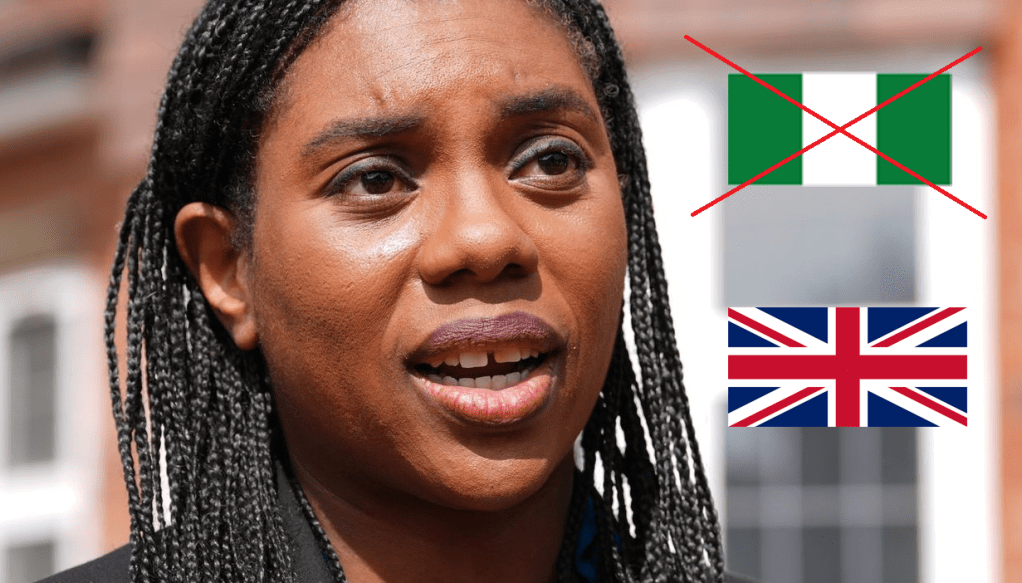
I’ve been following the outrage over Kemi Badenoch denying her Nigerian heritage.
I have mixed feelings about both the backlash and the now-infamous excerpt from her interview in which she said she no longer identified with Nigeria. While it is unusual for someone to distance themselves from their country of origin this much, it’s worth noting that Kemi has spent far more of her life outside Nigeria than within.
On a similar note, from my perspective, she seems less dismissive of Nigerians as a people than of Nigeria as a state – its systems and structures, which she feels failed her.
I agree that, as a public figure with significant influence, she should be mindful that her words impact not just her own image but also how the wider community and the country she is still linked to are perceived. Kemi is Nigerian whether she embraces “the ways of Nigeria” or not.
Some of her comments do baffle me. She is often vocal about her negative perceptions of the country, and I think she over-states them. But as someone of mixed heritage who is also Nigerian (and European), I’m uncertain how to feel about the backlash she has received, within the UK and Nigeria as well as the African diaspora all around.
Mixed heritage is complex on a personal level; I can only imagine how much harder it is to strike a balance when you are in the public eye and your loyalties (in her case, to the UK) are constantly tested.
Being mixed-race myself, I also understand what it means to have your heritage further complicated by belonging to different so-called “races” – a term I use reluctantly, as I don’t believe in dividing people this way; there is only one human race. Still, in acknowledging the current societal framework, Kemi’s husband is a white European man and her children are mixed-race.
Legal Barriers and Gender Bias
In the Nigerian context, expectations are shaped by a patriarchal system. For instance, within the context of mixed heritage, when a European woman marries a Nigerian man, she is usually expected to adopt his culture and traditions. This is especially true within Nigeria itself.
Moreover, according to the Nigerian Constitution, a woman who is, or has been, married to a Nigerian citizen may apply for citizenship by registration. This applies specifically to foreign women married to Nigerian men but does not extend to foreign men married to Nigerian women. Consequently, a foreign husband cannot obtain Nigerian citizenship through marriage to a Nigerian spouse like a foreign wife can. This legal framework reflects a gender imbalance, reflecting broader patriarchal norms.
I am not suggesting that Kemi Badenoch ever considered “choosing” Nigeria over the UK. But even if she had, her family circumstances would make life in Nigeria less favourable for her husband – because as a woman she could not pass Nigerian citizenship on to him.
Beyond the gender discrimination, this legal reality provides little incentive for a woman with the option of multiple nationalities to prioritise Nigeria, especially when she is not accorded the same rights as a man with the same capabilities – only because she is not a man.
Kemi Badenoch said she couldn’t pass on her Nigerian citizenship to her children because she is a woman. That is not true and disappointing to hear from someone in her position. However, what is true is that, again, her husband could not be considered Nigerian through marriage alone, while a foreign wife married to a Nigerian man could.
Beyond the gender imbalance, this reflects a cultural double standard: foreign wives are expected to adopt their Nigerian husbands’ traditions, yet Kemi is criticised for embracing her European husband’s culture instead.
That said, I do not support Kemi’s repeated criticisms of the country. Given her position, and the UK’s need to maintain healthy relations with its former colonies, it would be wiser for her to refrain… Still, I don’t believe that her simply saying she no longer identifies with Nigeria – or perhaps with its ways – after nearly three decades abroad and building a family with a European husband, warrants the scale of outrage she is receiving.
As I write this, trying to organise my thoughts, my feelings about this mixed-heritage dilemma remain, fittingly, mixed.
When Yoruba Feels More Honest
But then, there is yet another layer to this – found within her previous statements that she is not Nigerian but Yoruba (one of the country’s ethnic groups).
This view is not unusual amongst Nigerians and partly rooted in history: Nigeria did not begin as a single nation. Its borders were drawn largely by Britain during the Scramble for Africa in the late 19th and early 20th centuries. The separate ethnic groups existed long before Nigeria itself, and the amalgamation of these diverse peoples created a country in which not everyone is on the same page.
That’s a whole ‘other conversation that could be had maybe another time. However, for some insight into why some Nigerians identify less with the nation as a whole and more with their regions, watch this brief excerpt from my visit to the National Museum in Lagos.
Well, as Nels Abbey wrote in The Guardian, “These are trying times, but those of us who feel proudly able to carry multiple identities – enriched by that privilege and truth – will have to go on without Kemi. Nigerians will have to love her, accepting that love is unrequited. Black Britons will seek to know and understand her, even if she shows no obvious yen to know or understand them.”
In the end, I remain caught between criticism and empathy, born of the complexity of belonging. Like many, I hope that one day Kemi Badenoch reconsiders her dismissive attitude toward her motherland and that Nigeria, in turn, welcomes her “back home.”
Monika

 MIXED HERITAGE PRESS (MHP)
Leave a Reply